Most enterprise organizations are now at least experimenting with AI. Employees are using chat tools. Teams are testing automation. Leaders are approving pilots. Somewhere inside the organization, someone is probably building a proof of concept that looks impressive in a demo. But experimentation is not the same as enterprise value.
The next challenge for many organizations is not simply adopting AI. It is governing AI well enough that it can be trusted, measured, improved, and scaled. That is where AI governance becomes essential.
Why AI governance matters
Governance can sound bureaucratic, but in enterprise AI it serves a practical purpose: it creates the structure that allows AI systems to operate responsibly inside the business.
Without governance, AI initiatives can become scattered. One department may use a tool differently than another. Sensitive data may be handled inconsistently. Models may produce outputs that no one is monitoring. Business leaders may struggle to understand which AI projects are working, which are risky, and which should be scaled.
Good governance does not slow AI down. It gives AI a safe path forward.
From individual use to enterprise systems
There is a major difference between an employee using AI to draft an email and a company using AI to support a business process.
Individual AI use is often informal, flexible, and personal. Enterprise AI is different. It may influence customer communication, sales prioritization, fraud detection, operational decisions, financial forecasting, hiring workflows, support routing, or product recommendations.
Once AI touches real business processes, the stakes change. The organization needs to know: what data is being used? Who owns the process? How are outputs reviewed? What happens when the system is wrong? How is performance measured over time? Those are governance questions.
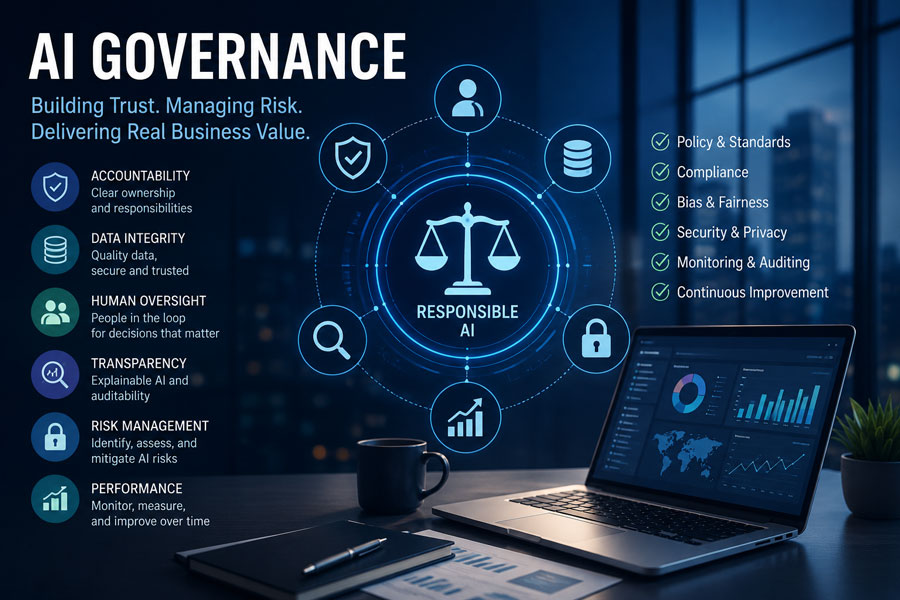
THE CORE PIECES OF PRACTICAL AI GOVERNANCE
AI governance does not need to begin as a massive policy initiative. For many organizations, it starts with a few practical disciplines.
Clear ownership
Every AI initiative should have an owner. That owner may sit in operations, marketing, sales, IT, compliance, product, or analytics, depending on the use case. But someone must be accountable for the business outcome and for how the AI system is used.
AI projects struggle when they are treated as “technology experiments” without business ownership. Enterprise AI needs a named owner, a defined purpose, and a clear connection to business value.
Data standards
AI systems depend on data. If the data is incomplete, outdated, biased, inconsistent, or poorly defined, the outputs will reflect those problems.
Governance should define which data sources are approved, how sensitive data is handled, and how data quality is checked before it is used in models or workflows. This is especially important when AI systems are connected to customer information, financial data, employee records, or proprietary business knowledge.
Human oversight
Not every AI output should be accepted automatically. Some systems can operate with low risk, while others require human review.
Governance helps define where humans stay in the loop. For example, an AI system might draft a customer response, but a support representative approves it. A model might score churn risk, but an account manager decides what action to take. A system might flag an anomaly, but an analyst investigates before escalation.
Human oversight is not a weakness. It is often what makes enterprise AI trustworthy.
Performance monitoring
AI systems are not “set it and forget it.” Data changes. Customer behavior changes. Markets change. Internal processes change.
That means AI performance must be monitored over time. Organizations should track both technical performance and business outcomes. Is the model still accurate? Are recommendations still useful? Are users adopting the system? Is it improving the metric it was designed to improve? Without monitoring, an AI system can quietly drift away from its original value.
Risk and compliance controls
Some AI use cases carry more risk than others. A brainstorming assistant is very different from a model that influences credit decisions, hiring recommendations, pricing, or customer treatment.
Governance helps classify risk levels and determine what controls are needed. These controls may include documentation, approval workflows, audit trails, security reviews, bias testing, and escalation procedures.
The point is not to make every project complicated. The point is to match the level of control to the level of risk.
Governance turns pilots into capabilities
Many AI pilots fail to scale because the organization never builds the operating structure around them. The demo works, but no one knows who owns it. The model performs in a test environment, but the data pipeline is fragile. The output is interesting, but the business process does not change. The tool gets attention for a few weeks, then fades
Governance helps prevent that. It gives AI projects a path from experiment to production. It clarifies who is responsible, how decisions are made, how performance is measured, and how risk is managed. In other words, governance is what turns scattered AI activity into repeatable enterprise capability.
The practical starting point
For companies early in their AI journey, the goal should not be to create a giant governance bureaucracy. A better starting point is to build a simple AI governance checklist for any project that moves beyond personal productivity.
That checklist might ask:
- What business process does this support?
- Who owns the outcome?
- How will outputs be reviewed?
- How will success be measured?
- How will performance be monitored over time?
These questions are simple, but they force the organization to think clearly. And clear thinking is one of the most important ingredients in successful AI adoption.
Bringing it all together
AI governance is not just about rules. It is about making AI dependable enough to matter.
Companies that want real enterprise value from AI need more than tools, pilots, and enthusiasm. They need structure, ownership, monitoring, and trust. That is the missing layer between experimentation and business impact.